Quick reference · Communication
Communication glossary コミュニケーション用語集
The shared terms for every communication lesson. Use these words when diagnosing an exchange.
Six traits 六つの資質
| Trait | 日本語 | Means | Test question |
|---|---|---|---|
| Clarity | 明確さ | What, who, and by when are unmistakable. | Could they act without asking what I meant? |
| Openness | 開放性・オープンさ | Share information and reasoning with those affected; invite input. | Did everyone affected hear it before it was final? |
| Honesty | 誠実さ・正直さ | Say what you believe, including unwelcome news. | Does it match what I privately think? |
| Timeliness | 適時性・タイムリーさ | Arrives while it can still change a decision. | When did I know, and when did they hear? |
| Accuracy | 正確さ | Matches the facts, with evidence to back it. | What is my evidence? |
| Listening | 傾聴力 | Understand the whole meaning—facts and feelings—before responding. | Could I restate their point to their satisfaction? |
Honesty vs accuracy follows Grice's maxim of Quality (SEP). Listening: Rogers & Farson, Zenger & Folkman.
Seven barriers 七つの壁
From Victor's company training. Short glosses are provisional until aligned with the training material.
| 日本語 | English | Gloss (provisional) |
|---|---|---|
| 期待・思い込み(パラダイム) | Expectations, assumptions (paradigm) | We hear what we expect to hear. |
| 動機(目的・ゴール) | Motive (purpose, goal) | Each side filters the message through what it is trying to achieve. |
| 感情(気分・フィーリング) | Emotion (mood, feeling) | Current mood colours how a message is sent and received. |
| 先入観(関心事) | Preconception (concerns) | What we already care about decides what we notice. |
| 専門用語(業界用語・専門的表現) | Jargon (industry terms) | Terms clear to the sender are opaque to the receiver. |
| 偏見(過去の経験) | Bias (past experience) | Past experience with a person or topic shapes the reading. |
| 個性・性格(行動、学習スタイル) | Personality (behaviour, learning style) | People differ in how they prefer to take in and give information. |
Culture 文化の違い
| Term | 日本語 | Means |
|---|---|---|
| Low-context | 低コンテクスト | Meaning is in the words; say it explicitly, repeat it in writing. |
| High-context | 高コンテクスト | Meaning relies on shared background and what is left unsaid. |
| Reading the air | 空気を読む | Sensing the unspoken mood and expectations of a group. |
| Consensual deciding | 合意型の意思決定 | Slow, broad agreement; the decision then stays fixed. |
| Top-down deciding | トップダウン型 | One person decides quickly; the decision may change often. |
| Ringi | 稟議 | A proposal circulates for input and approval, level by level. |
Positions on these scales are relative: what matters is where you sit compared with the other person. Source: Erin Meyer, “Navigating the Cultural Minefield” (HBR, 2014).
Meetings and conflict 会議と衝突
| Term | 日本語 | Means | Move |
|---|---|---|---|
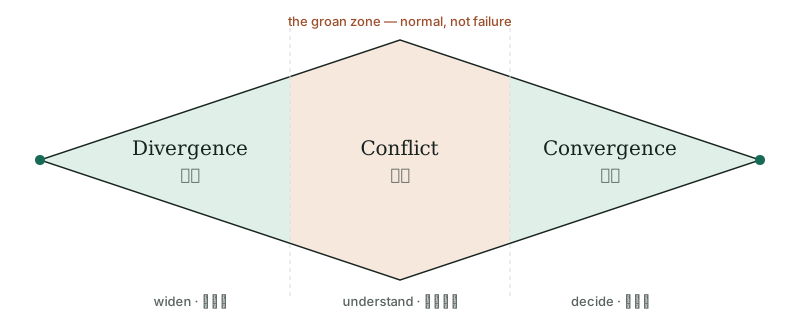
| Divergence | 発散 | The discussion widens; views are added. | Collect; judge later. |
| Conflict (groan zone) | 衝突(混沌) | Views collide; repetition, interruption, defensiveness. Normal, not failure. | Restate each side; ask what each needs. |
| Convergence | 収束 | The discussion narrows to a decision. | Name the decision rule; say decision, owner, deadline. |
| Hidden conflict | 表に出ない衝突 | Disagreement moved to silence or hallway talk. | Invite it into the room; check who can't live with it. |
| Task conflict | タスク・コンフリクト | Disagreement about the work. On average not harmful. | Keep it here. |
| Relationship conflict | 関係コンフリクト | Friction about people. Harms teams. | Separate the people from the problem. |
| Position | 立場・主張 | What someone says they want. | Ask “why?” |
| Interest | 利害・本当のニーズ | Why they want it: the underlying need. | Solve for this. |
| Gradients of agreement | 合意の度合い | Kaner's 8-point scale from whole-hearted endorsement through “I can live with it” to veto. | Use instead of yes/no. |
| Consent check | 「これで行けない人は?」 | A convergence move that surfaces leftover objection before closing. | If someone objects, return to 衝突. |
| Domination / compromise / integration | 支配・妥協・統合 | One wins / both give up something / a new option meets both needs. | Aim for integration. |
Kaner et al. (2014); 日本ファシリテーション協会; de Wit, Greer & Jehn (2012); Fisher & Ury, Getting to Yes; Follett (1925).