発散 Divergence → widen
Collect views; hold judgement until later. “What else?”
Mistake: judging each idea as it arrives.
Lesson 3 · Communication · Conflict
Every real decision passes through an uncomfortable middle. Once you can name it, you stop fearing it—and you know what to do next. 本当の意思決定は必ず居心地の悪い「真ん中」を通る。名前をつければ怖くなくなり、次の一手が見える。
Conflict in a meeting is not a sign that something went wrong. It is the sign that different views have finally met. 会議での衝突は失敗の印ではない。異なる見方がようやく出会った印だ。
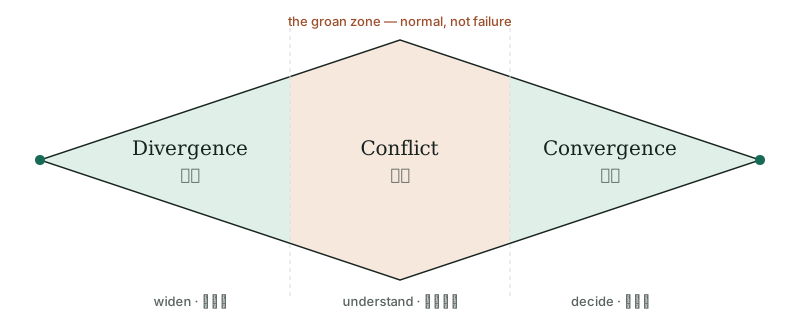
Sam Kaner's Facilitator's Guide to Participatory Decision-Making draws group decisions as a diamond. First the discussion widens as people add views. Then comes the groan zone: views collide, people repeat themselves, interrupt, get defensive. Only after that does the discussion narrow to a decision. Kaner treats the groan zone as a normal stage—not a breakdown—and the place where creative breakthroughs tend to come from.
日本のファシリテーションでは同じ流れを「発散・混沌・収束」と呼ぶことが多い(日本ファシリテーション協会・堀公俊)。本コースでは「衝突」を使う。
A long meeting often runs this loop several times—once per agenda item, or once per sub-question inside one item.
Sources: SARE summary of Kaner et al. (2014); Chris Corrigan, “The Diamond of Participation”; 日本ファシリテーション協会「ファシリテーションとは」.
Collect views; hold judgement until later. “What else?”
Mistake: judging each idea as it arrives.
Restate each side until they agree you've got it. Ask what each side needs, not what it wants.
Mistake: forcing a vote to escape the discomfort.
Name how you'll decide, then say the decision, owner, and deadline out loud.
Mistake: assuming everyone heard the same decision.
“We're in the hard middle part—that's normal. Let's make sure we understand each view before choosing.”
Naming the stage lowers the temperature.
A meta-analysis of 116 studies (de Wit, Greer & Jehn, 2012) found that disagreement about the work—task conflict—was, on average, neither good nor bad for team performance. Conflict about people—relationship conflict—was the kind that hurt. So the aim is not to avoid conflict, but to keep it about the problem. Getting to Yes puts it as “separate the people from the problem.”
仕事の中身についての衝突は、平均すると成果を損なわない。損なうのは人間関係の衝突。だから衝突を避けるのではなく、「人」ではなく「問題」に向ける。
And convergence doesn't have to mean someone loses. Mary Parker Follett (1925) separated three outcomes: domination (one side wins), compromise (both give something up), and integration—a new option where both get what they actually need. Her example: two people in a library disagree about an open window; opening a window in the next room gives one fresh air and spares the other the draft. Integration is the next lesson.
Sources: de Wit, Greer & Jehn, J. Applied Psychology 97(2), 2012; Harvard Program on Negotiation on Getting to Yes; Follett, “Constructive Conflict” (1925).
Practice 1 · Which zone?
“Let's list every way staff currently find HR forms—no idea is too small.”
Sales wants employee self-service. Legal says self-service risks privacy leaks. Each has repeated their point three times.
“Before we close: is there anyone who can't live with option B?”
The section chief proposes a plan. Nobody speaks. Afterwards, two members complain about it in the hallway.
“What would the department heads say if they were here? Let's add their likely views to the board.”
Practice 2 · Choose the move
Payroll and General Affairs have each restated their position three times. Voices are rising.
Ten minutes into brainstorming how to announce the new portal, a senior manager says “That won't work” to each idea.
Everyone seems to agree, time is up, and people are packing up.
Review from Lesson 2: restating each side until they say “Yes, exactly” mostly draws on which trait?
Primary reading: Sam Kaner et al., Facilitator's Guide to Participatory Decision-Making (3rd ed., 2014), chapter 1 on the diamond. Free starting point: Chris Corrigan's summary. In Japanese: 堀公俊『ファシリテーション入門』(日経文庫).
Questions are part of learning. Ask your teacher (Claude) about anything unclear, or bring a real meeting that got stuck and we'll map where it stalled.